




Gold is one of the most traded instruments in global financial markets, and knowing when to trade it is just as important as knowing how. The best time to trade gold directly impacts the spreads you pay, the quality of price movement available, and the probability of your setups working out. This guide covers the key trading sessions, the most active windows for XAUUSD, and the factors that drive gold volatility — so you can trade at the right time, every time. Want to trade gold at the right time, every time? Sign up with Trendo and get real-time XAUUSD pricing on your phone.
What Is the Best Time to Trade Gold (XAUUSD)?
Gold (XAUUSD) trades 24 hours a day, five days a week, but not all hours are equal. The market’s behavior changes dramatically depending on which global financial centers are open. During peak hours, institutional traders, hedge funds, and banks drive strong directional moves with tight spreads. During off-peak hours, liquidity thins out, spreads widen, and price action becomes erratic and unreliable.
The core principle is simple: trade when the market is most liquid. That is when setups are cleanest, execution is sharpest, and the risk of false moves is lowest.
Gold Market Volatility Throughout the Day
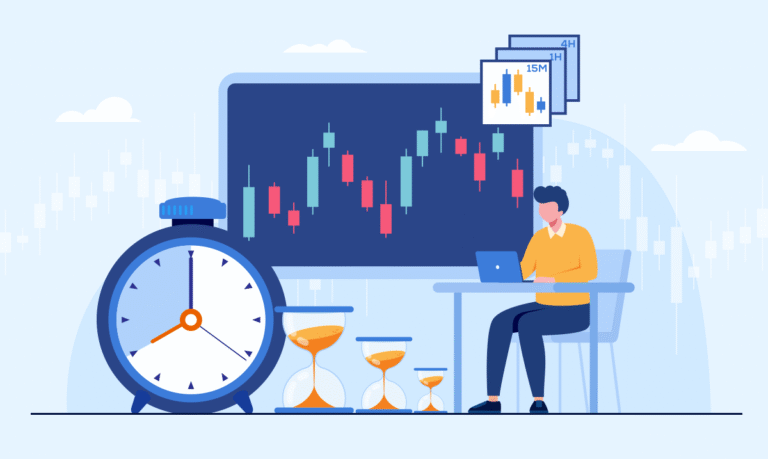
Gold volatility follows a consistent daily pattern across four major sessions:
- Asian session (00:00–09:00 GMT): The quietest period. Price is often range-bound with wider spreads and minimal institutional participation.
- London session (08:00–17:00 GMT): Volatility rises sharply. London is the global hub for OTC spot gold trading, and this session sets the directional tone for the day.
- New York session (13:00–22:00 GMT): The second major volatility spike. US economic data releases drive some of gold’s sharpest intraday moves.
- London–New York overlap (13:00–17:00 GMT): The highest-liquidity window of the entire gold trading day — consistently the best time to trade gold for active traders.
Understanding Gold Trading Sessions

Asian Session and Gold Trading
The Asian session is generally the least active period for XAUUSD. With lower volume and minimal institutional flow, price tends to consolidate rather than trend. For most day traders and scalpers, this is not the best session to trade gold. However, the ranges established during Asian hours often serve as key reference points for London traders, making it useful for planning rather than executing.
London Session and Gold Volatility
When London opens at 08:00 GMT, the gold market comes alive. London hosts the highest OTC gold trading volume of any session and includes two key benchmark events, the London AM Fix (10:30 GMT) and the London PM Fix (15:00 GMT), which are used by major bullion banks to settle institutional contracts globally. European economic data released between 08:00–10:00 GMT can also shift USD sentiment indirectly, moving gold in the process.
Key advantages of trading gold during the London session:
- Significantly tighter spreads than during Asian hours
- Strong institutional order flow creating cleaner price action
- Two daily benchmark events providing structurally predictable price activity
- Ideal conditions for both technical and fundamental strategies
For traders who want active but not explosive conditions, the early London session (08:00–12:00 GMT) is among the best hours to trade gold.
New York Session and XAUUSD Activity
The New York session opens at 13:00 GMT and immediately overlaps with London for four hours — the most powerful window of the day. The standalone New York session (17:00–22:00 GMT) sees declining volume as European traders close positions, but the opening hours are critical. This is when the majority of high-impact US data hits the market: CPI, Non-Farm Payrolls (NFP), and FOMC statements. Because gold is priced in US dollars and inversely correlated with USD strength, these releases regularly produce the largest intraday moves in XAUUSD.
London–New York Overlap: The Most Active Trading Hours
The London–New York overlap (13:00–17:00 GMT / 08:00–12:00 EST) is the definitive answer to the question of the best time to trade XAUUSD. During this window, both the world’s leading OTC gold market (London) and the primary gold futures exchange (COMEX, New York) are simultaneously active. Institutional order flow from both centers converges, pushing volume to its daily peak.
This overlap also captures the London PM Fix at 15:00 GMT and US economic data releases at 13:30 GMT, a powerful combination of scheduled catalysts. The result is:
- Tightest spreads of the trading day
- Strongest and most sustained directional moves in XAUUSD
- Cleanest institutional setups with the lowest risk of false breakouts
- Maximum volume, making entries and exits more reliable
Many professional traders focus almost exclusively on this 4-hour window, treating it as their primary trading period.
Best Time to Trade Gold in Forex by Strategy
Best Hours to Trade Gold for Day Traders
For day traders, the London–New York overlap is the core session. The US economic releases at 13:30 GMT often create immediate, high-probability setups right at the overlap’s start. Traders using the Trendo platform can take advantage of fast execution and competitive spreads during these high-activity hours. Pairing session timing with an economic calendar is essential for identifying which days within the overlap carry the most significant catalysts.
Best Time to Trade Gold for Scalpers
Scalpers need tight spreads and fast price movement above all else. The best time to trade gold on forex for scalping is the first 60–90 minutes of the London–New York overlap (13:00–14:30 GMT), when volume is surging, and spreads are at their narrowest. A platform built for low-latency execution (like Trendo) is not optional for scalping XAUUSD; it is a core requirement. Even a few extra pips in spread cost, compounded across many trades, can turn a profitable strategy into a losing one.
Best Time to Trade Gold for Swing Traders
Swing traders work on multi-hour to multi-day timeframes and are less dependent on specific session windows. However, even swing traders benefit from opening positions during London or New York hours to ensure better execution prices. The Asian session can be used for analysis and planning — watching how price develops within its range before committing to direction at the London open. A trading calculator helps define exact position sizes and risk levels before entering any swing trade.
Why Gold Becomes More Volatile During Certain Sessions
- Economic News Releases
- US Dollar Movements and Central Bank Policy
- Geopolitical Events
Economic News Releases
The most predictable volatility spikes in gold occur around scheduled US data releases. Because gold is priced in dollars and functions as a hedge against economic uncertainty, it reacts sharply to any data that shifts Federal Reserve rate expectations. The highest-impact releases include NFP (first Friday of each month, 13:30 GMT), CPI, and FOMC statements — all occurring during New York hours, reinforcing why this session produces the best time to trade gold in forex for news-driven strategies.
US Dollar Movements and Central Bank Policy

Gold shares a well-established inverse relationship with the US dollar. Strong USD typically pushes gold lower; weak USD pushes it higher. Federal Reserve decisions — rate hikes, rate cuts, or changes in forward guidance — are among the single most powerful catalysts for sustained directional moves in XAUUSD. Traders using an ECN forex account benefit from direct market access and tighter pricing during these high-volatility events.
Geopolitical Events
Gold’s status as a safe-haven asset means it can spike sharply during unexpected geopolitical events — conflicts, financial crises, or major political developments — at any time of day. While these events cannot be scheduled, they reinforce the importance of always managing risk carefully, regardless of session timing.
Common Mistakes When Trading Gold at the Wrong Time
- Trading During Low Liquidity Hours
- Ignoring Market Overlaps
- Trading News Without a Plan
Trading During Low Liquidity Hours
The period between the New York close and Sydney open (22:00–00:00 GMT) is the lowest-liquidity window of the week. Spreads widen, price action becomes choppy, and the risk of slippage increases sharply. This is not the best time to trade gold on forex — and many traders learn this lesson the hard way.
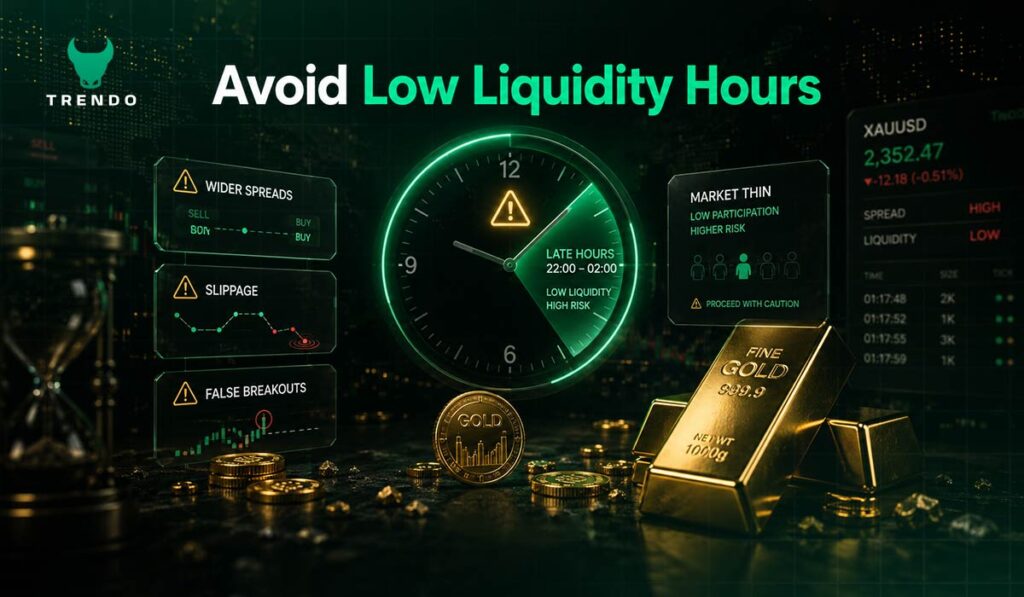
Common low-liquidity risks include:
- Wider spreads: higher cost on every entry and exit
- False breakouts: moves that reverse quickly with no follow-through
- Order slippage: fills at prices worse than intended
Ignoring Market Overlaps
Choosing a fixed daily trading schedule without accounting for session structure is a common mistake. Traders who ignore the London–New York overlap miss the window where the best hours to trade gold consistently occur. Aligning your active trading time with peak liquidity is one of the simplest improvements any trader can make.
Trading News Without a Plan
High-impact releases like NFP can move gold by $20–$50 in minutes. Without predefined entry criteria, stop placement beyond the volatility range, and a clear profit target, news trading often leads to large, fast losses. The best time to trade gold is not automatically the safest time; disciplined risk management is always required.
Trading Gold With the Right Broker Conditions
Knowing the best time to trade gold is only half the equation. The other half is having access to the right trading conditions when those windows arrive. Trendo is built for active gold traders, offering competitive spreads on XAUUSD, fast order execution, and a stable platform that performs reliably during high-volatility sessions. The mobile app ensures you never miss the optimal window, whether you are at your desk or on the move. New traders can register with Trendo and kick-start their trading journey with a $100 welcome bonus.
Conclusion
The best time to trade gold is not a single hour; it is a structured set of windows where liquidity, volatility, and institutional participation align. The London–New York overlap (13:00–17:00 GMT) consistently offers the most productive conditions for day traders and scalpers. At the same time, the standalone London and New York sessions each provide distinct advantages for different strategies. Avoiding low-liquidity hours, timing trades around major US data releases, and choosing a broker with tight spreads and fast execution are the practical steps that turn session knowledge into real trading edge.